

How Sensing Edges Work
Miller Edge sensing edges are pressure sensitive safety devices designed to detect obstructions and protect against accidents in various applications, such as motorized doors, automated gates, and motorized industrial equipment. Our sensing edges are available in a variety of models to easily adapt to any application.

All electrically activated edges operate on the same basic principle referred to as a Normally Open (N.O.) electrical configuration:
- Miller Edge sensing edge exteriors are typically made of flexible PVC or vinyl and contain conductive elements separated by a gap. These elements run throughout the length of the edge.
- When an object or person comes into contact with a sensing edge, the flexible exterior compresses and the internal conductive elements come into contact with each other. This contact completes an electrical circuit.
- When the circuit is completed, it generates an electrical signal. This signal is then transmitted to the control system or motor of the door, gate, or machinery.
- The control system receives the signal and responds by immediately stopping or reversing the movement of the door, gate, or equipment.
UL 325 Compliance
Effective August 31, 2010, the UL 325 safety standard requires motorized doors installed with momentary contact on the down control to require the installation of a monitored reversing device.
With a monitored device, the motor controls are able to check for the presence and operation of the reversing system.
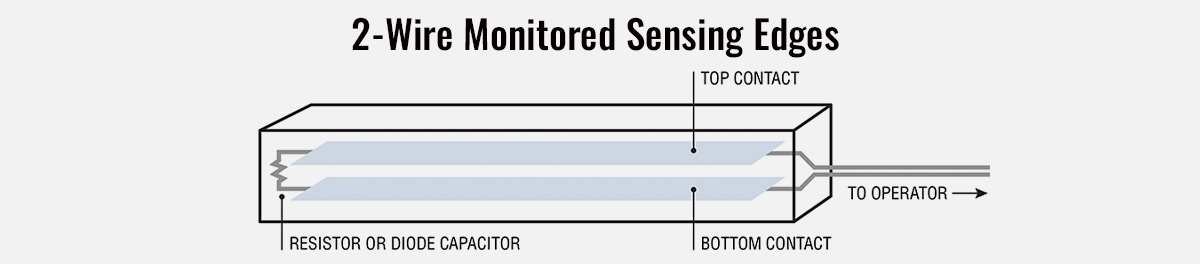
A 2-wire monitored sensing includes a termination resistor or diode capacitor at the end of the sensing edge. This monitored configuration can be specified at the time of order based on the requirements of the operator. Monitored sensing edges offer an additional layer of safety by providing feedback to the control system about their operational status. This continuous monitoring ensures that the sensing edge is functioning correctly, reducing the risk of false positives or negatives due to edge damage or wear.
Advantages:
- Simplicity: 2-wire non-monitored sensing edges are straightforward and easy to connect to operator controls.
- Monitored Safety: They provide a monitored safety function, continuously checking the circuit for faults or failures. The termination resistors at the end of the edge helps ensure proper operation and signal integrity.
Limitations
- Compatibility: Monitoring methods vary by operator brand. It’s essential to ensure that sensing edge monitoring method is in alignment is alignment with the operator. It’s crucial to verify that the selected monitoring method aligns with your operator. To confirm the edge’s monitoring method matches the operator, consult the operator manufacturer’s manual. For your convenience Miller Edge provides the termination resistor or diode capacitor required by most operator brands.
In summary, 2-wire monitored sensing edges offer a balance between simplified installation and monitored safety. However, monitoring compatibility considerations are important when selecting them for a specific application.
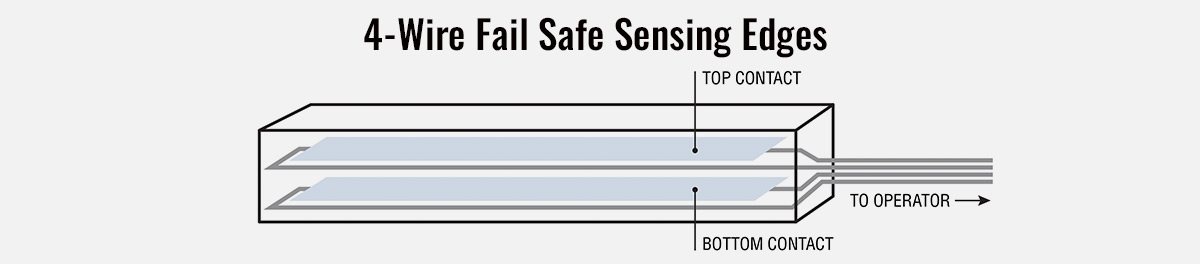
A 4-wire fail-safe sensing edge consists of four wires and is designed to ensure a fail-safe operation, meaning it’s engineered to detect and respond to faults or failures in a way that prioritizes safety. Here are the pros and cons of 4-wire fail-safe sensing edges:
Advantages:
- Enhanced Safety: The primary advantage of a 4-wire fail-safe sensing edge is its ability to detect faults, such as wire breaks or sensor failures, and respond by opening the circuit to stop motion. This ensures that even if there is a problem with the sensing edge, the door or gate will not pose a safety risk.
- Reliability: These sensing edges are known for their reliability. The fail-safe design reduces the likelihood of false readings or malfunctions that could compromise safety.
- Compliance: Many safety regulations and standards, including UL 325, require the use of fail-safe devices in certain applications. Using a 4-wire fail-safe sensing edge helps ensure compliance with these regulations.
Limitations:
- Complexity: Compared to simpler sensing edge designs, 4-wire fail-safe sensing edges can be slightly more complex to install. They require careful wiring and configuration to ensure proper operation.
In summary, 4-wire fail-safe sensing edges are designed with a strong emphasis on safety and reliability, making them suitable for applications where safety is of utmost importance, such as industrial and commercial settings. However, their complexity and cost should be considered when selecting them for a specific project, and proper installation and maintenance are essential to ensure their effectiveness.
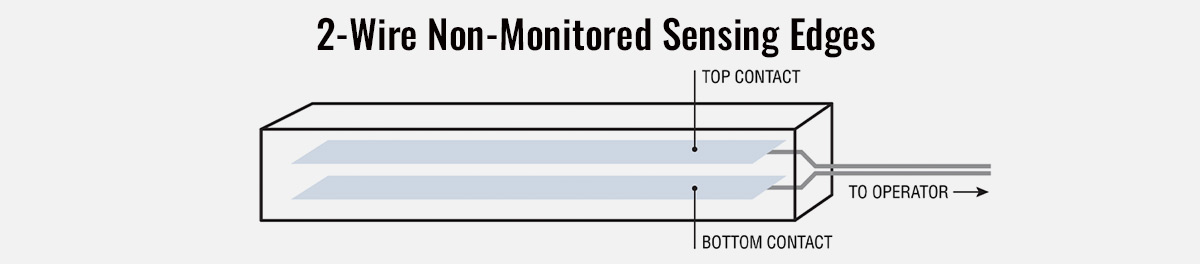
Unlike monitored sensing edges, non-monitored sensing edges do not have a feedback mechanism that continuously checks their status or functionality.
Advantages:
- Simplicity: 2-wire non-monitored sensing edges are straightforward and easy to connect to operator controls.
- Reliability: They are generally reliable in detecting obstructions and initiating safety measures, which helps prevent accidents and damage.
Limitations:
- Limited Diagnostic Capability: One of the main drawbacks of non-monitored sensing edges is their lack of diagnostic capability. They cannot provide real-time feedback on their condition or functionality. If a non-monitored sensing edge becomes damaged or fails, there may be no immediate way to know.
- Potential for Unnoticed Failures: Since there is no continuous monitoring, a non-monitored sensing edge may become damaged or malfunction without anyone noticing until an accident occurs or it’s manually inspected.
- Reduced Safety: In situations where the sensing edge may be subject to wear and tear, exposure to harsh conditions, or potential damage, relying solely on a non-monitored sensing edge may not provide the same level of safety assurance as a monitored system.
- Compliance Issues: 2-wire non-monitored sensing edges are not compatible with the current UL 325 safety standard as a primary entrapment device on motorized industrial/commercial doors and automated vehicular gates.
Air-activated sensing edges activate with air pressure.
- Miller Edge air-activated sensing edge exteriors are typically made of flexible PVC or vinyl and contain a flexible hose that is sealed on one end. One the other end the hose is connected to an air switch with diaphragm on the opposite end.
- When an object or person comes into contact with a sensing edge, the flexible exterior compresses and the hose pushes air into the diaphragm, activating the switch. This contact completes an electrical circuit.
- When the circuit is completed, it generates an electrical signal. This signal is then transmitted to the control system or motor of the door, gate, or machinery.
The control system receives the signal and responds by immediately stopping or reversing the movement of the door, gate, or equipment.
Air-Wave Sensing Edges
Air-Wave sensing edges operate using air pressure technology to detect obstructions and provide safety by triggering a door or gate to stop and/or reverse motion.
Advantages:
- Wide Coverage: Air-Wave sensing edges can offer wide coverage, making them suitable for larger doors or gates.
- Durability: They are built to withstand tough industrial environments, including exposure to weather, extreme temperatures, and physical impacts.
- Adjustable Sensitivity: Due to the built-in adjustable sensitivity on the Air-Wave switch (sold separately), Air-Wave edges perform very well in cold temperatures as well as on high-vibration doors.
- Low Cost: They can be a cost-effective solution, especially for applications that require wide coverage, as a single Air-Wave sensing edge can protect a significant area.
Limitations:
- Maintenance: While durable, they can still require periodic maintenance, including checking air pressure and ensuring proper functioning.
- Compatibility: Compatibility with various control systems and operators may vary, so it’s essential to ensure they work seamlessly with your specific setup.
- Compliance Issues: Air-Wave sensing edges are not compatible with the current UL 325 safety standard as a primary entrapment device on motorized industrial/commercial doors and automated vehicular gates.
In summary, Air-Wave Sensing Edges offer advantages in terms of non-contact sensing and wide coverage, making them suitable for certain industrial applications. The choice between them depends on the specific safety compliance requirements.
Pneumatic Sensing Edges
A pneumatic sensing edge operates by using changes in air pressure to detect obstructions or contact, triggering the door or gate to stop and/or reverse motion.
Advantages:
- Wide Coverage: Pneumatic sensing edges can be customized to provide wide coverage, making them suitable for large doors or gates.
- Durability: They are typically designed to be durable and resistant to environmental factors, making them suitable for outdoor applications and harsh conditions.
- Reliability: They have a reputation for reliability and consistent performance in industrial settings.
- Low Cost: They can be a cost-effective solution, especially for applications that require wide coverage, as a single pneumatic sensing edge can protect a significant area.
Limitations:
- Initial Setup: Installation and setup of pneumatic sensing edges can be more complex compared to some other types of safety devices. It may require expertise in pneumatic systems.
- Maintenance: While they are generally durable, pneumatic sensing edges may require occasional maintenance to ensure proper functioning. This can involve checking for air leaks and ensuring the system is calibrated correctly.
- Compatibility: Compatibility with specific door or gate operators may vary, so it’s essential to ensure that the chosen pneumatic sensing edge is suitable for the operator in use.
Overall, pneumatic sensing edges are valued for their non-contact sensing capabilities and durability, but they may require careful setup and maintenance to ensure optimal performance. The suitability of pneumatic sensing edges for a particular application should be assessed based on the specific needs and conditions of the installation.

Bumpers do not contain sensors and do not meet the UL 325 requirement. Rather, bumpers are used where extra cushioning is required as a cost-effective, highly visible, physical barrier. Bumpers may not provide the same level of safety and precision as monitored sensing edges. The choice between bumpers and sensing edges depends on the specific safety needs and compliance requirements of the installation.