

BEYOND THE BEAM: WHY FIRE STATIONS NEED LIGHT CURTAIN PROTECTION
Walk into a busy apparatus bay, and you’ll quickly see why a single point of stationary detection can leave gaps when safeguarding an overhead door opening. A pumper truck is backing out while a firefighter jogs past the threshold. A ladder truck’s mirror sticks out a foot past the cab. The rig sits higher off the ground than the single-beam photo eye mounted six inches above the floor. There’s no room for error when something gets missed, and the consequences can extend beyond property damage to the people moving through the opening.
For door dealers, the question isn’t whether the door needs safeguarding. It’s whether the protection in place matches what’s actually moving through the opening.
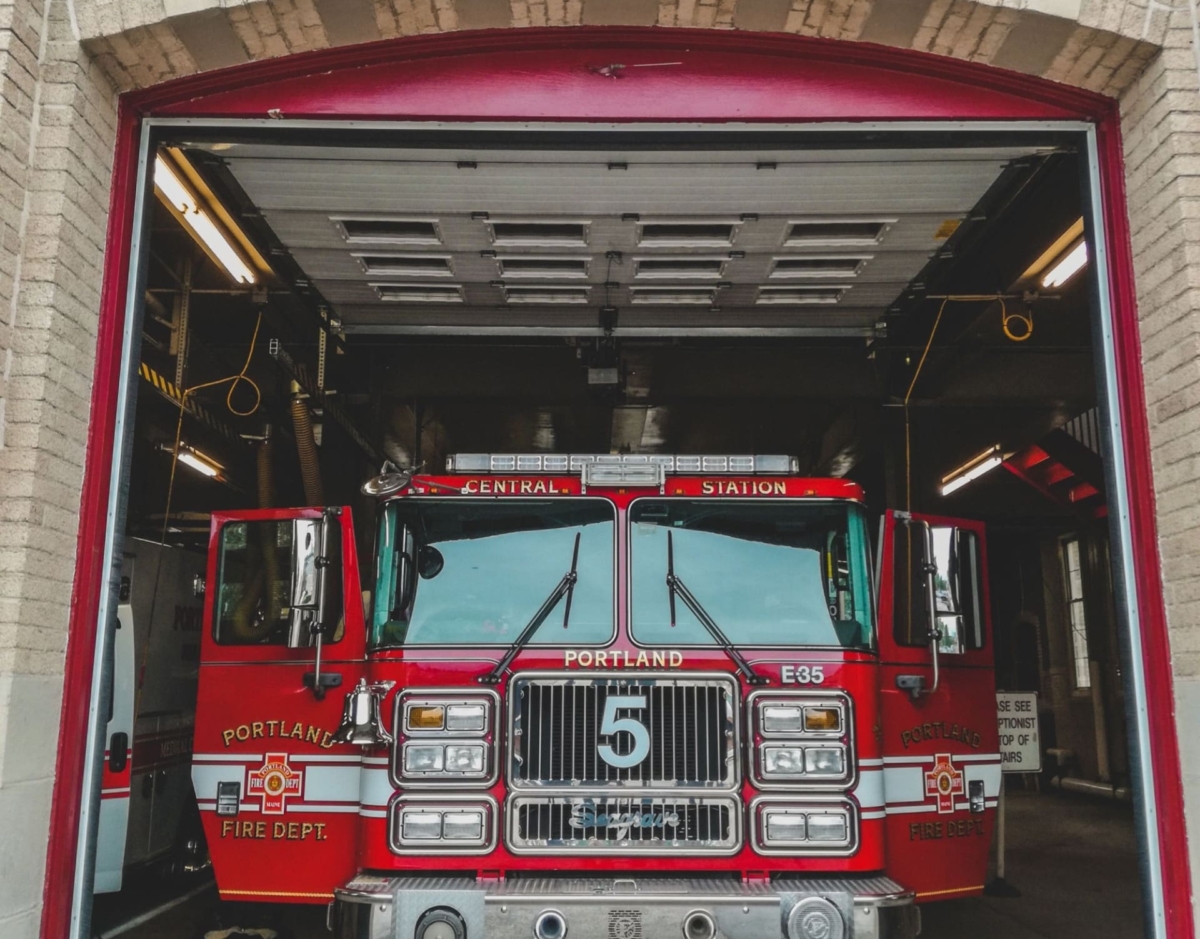
The Detection Gap in Fast-Moving Environments
Entrapment protection can use contact devices, such as sensing edges, or non-contact devices, including single-beam photo eyes and multi-beam light curtains.
Sensing edges provide contact-based entrapment protection by signaling the operator when an obstruction is encountered. Light curtains provide non-contact detection across an extended vertical area. Depending on the application, these technologies can be used independently or together to provide different levels of protection
Unlike sensing edges, static-mount, single-beam photo eyes provide detection without requiring contact. However, a single-beam photo eye monitors only one fixed height and is often installed near the floor in accordance with applicable requirements. This is perfectly fine for consistent, predictable traffic, but fire apparatus is neither consistent nor predictable.
At a fire station, truck profiles vary by model and by load; an empty tanker sits differently than a full one. Overhang above the front and rear tires, mirrors, ladders, and other equipment can extend well beyond the main body of the vehicle, and well above a single detection point. Personnel moving through the opening on foot, often at a run during a call, occupy positions and heights a single low beam was never designed to detect. A static-mount sensor is only ever watching one slice of what’s actually moving through that door.
For door dealers talking to fire service professionals, that’s a point worth making clearly: the door isn’t just protecting trucks and equipment from damage. Its detection system also plays an important role in helping protect personnel moving through the opening.
How Extended Vertical Detection Changes the Equation
A light curtain closes this gap by covering an extended vertical field instead of detection at a single fixed height, so it catches what a single beam misses and signals the operator before contact happens.
That matters most where contact carries real consequences, for people and for property. A damaged door may mean a truck out of operation, or a bay out of service, at a facility that can’t afford to be without a working door.
Miller Edge’s Levels of Protection Guide is a handy tool for customer conversations. The idea is simple: match your level of protection to what’s moving through the opening and the conditions around it. Single-beam photo eyes cover the low zone well, but multi-beam light curtains, available in 3-ft. and 6-ft. protection heights, extend coverage significantly. Use the guide to show customers exactly where their current setup falls short.
Proof From the Field: The Winchester Case Study
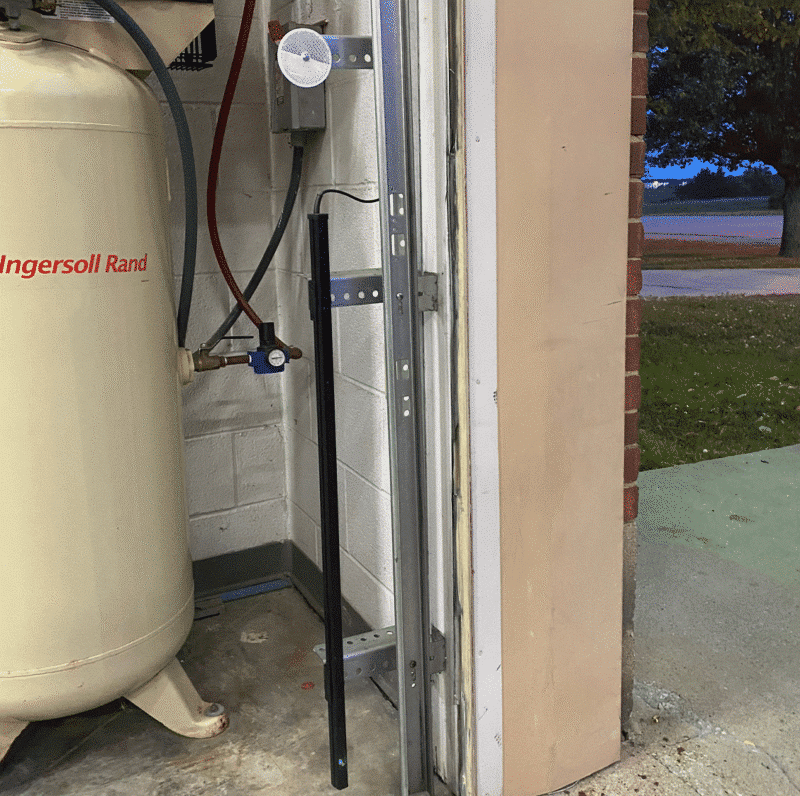
Miller Edge Light Curtain (MLC-K36) installed in multiple apparatus bays at the Winchester, Kentucky Fire Department
Winchester, Kentucky Fire Department is a good example of what that gap looks like in practice.
The department runs six overhead sectional doors across four bays. Before switching to light curtains, single-beam photo eyes were the only protection in place, and they weren’t catching the trucks consistently. An empty truck sits differently than a loaded one, and the front of an empty truck often didn’t break the beam at all, which meant the door would close on it. That gap cost the department two damaged doors and a damaged truck hood before their dealer installed Miller Edge light curtains across all six bays.
The result was extended vertical detection that better accounted for the varying profiles of the fire apparatus, demonstrating the value of broader non-contact protection in this type of application. It’s also a reminder that in an application like this, the value goes beyond preventing damage to the door or the vehicle. A damaged door can take an apparatus out of service or slow a response, and a fire station has to stay operational. You can read the full case study here.
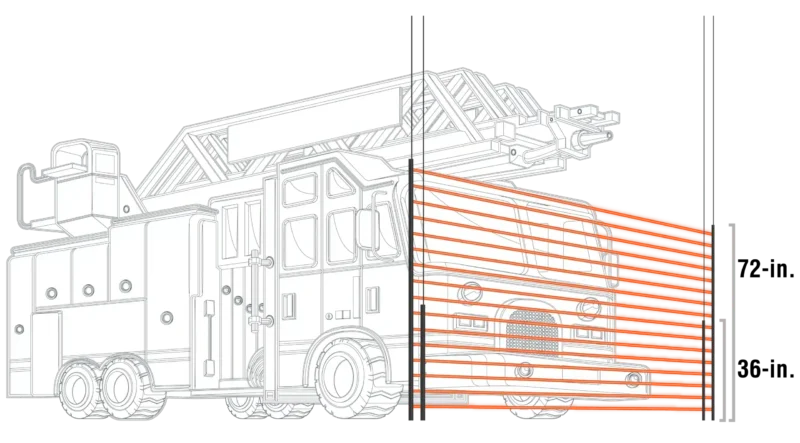
Diagram of a fire truck with two Light Curtain–DUO beam arrays overlaid, showing 36-in. and 72-in. detection heights against the vehicle’s profile.
One Light Curtain, More Compatibility
Light Curtain–DUO simplifies light curtain selection by combining three common output types — pulsed monitored, normally open relay, and normally closed relay — in one device. Instead of stocking a separate light curtain for each output type, dealers can use one model across a wider range of commercial door operators.
For dealers, that means fewer models to stock, simpler product selection, and less risk of choosing the wrong light curtain for an operator. Light Curtain–DUO is available in the same two protection heights as our previous MLC and RLC models: MLC-K36-DUO (3-ft.) and MLC-K72-DUO (6-ft.), with a 32-ft. operating range and a dense infrared detection field.
With output compatibility simplified, selecting the right Light Curtain–DUO model comes down to choosing the protection height that best fits the application.
Helping Customers Choose the Right Fit
Selecting the appropriate Light Curtain–DUO model requires considering the specific application. What’s moving through the door? What detection coverage does the application require? What are the consequences if something is missed?
If you’re evaluating light curtain protection for a fire station, apparatus bay, or other fast-moving environment, talk to Miller Edge about the right fit for your doors.